
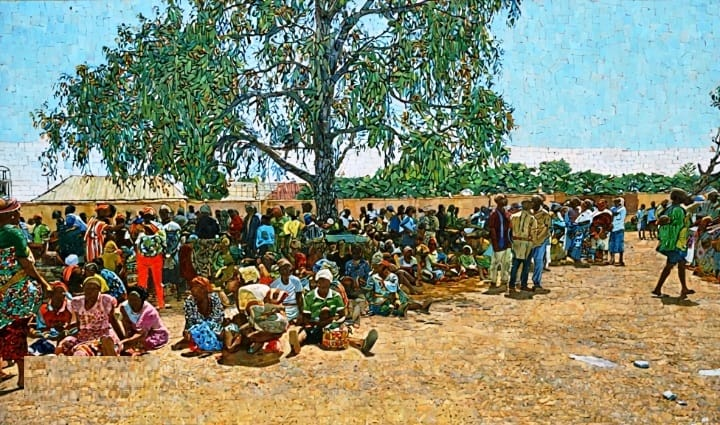
Saturday Vanguard visits Benue camp, captures human cost of Nigeria’s crisis
I see children, then I realise all mine are dead —Terrorism victim
Stop sending words, let’s return home without fear of being killed in our sleep —another victim
You failed to protect us, don’t fail to take us home; We want our lives back
By Stephanie Shaakaa
Before the sun rises over the plains of Benue, the camps stir. Not with the rhythm of village life, but with the uneasy movement of people who have nowhere else to go.
A mother bends over a small fire, coaxing a reluctant flame to life. Nearby, a baby cries in a makeshift cot, its mat still damp from the night rain. Children rub their eyes and drift toward a class under a tree, hoping a volunteer teacher will show up. Tarpaulin shelters stretch into the distance, held together by rope, plastic, and fading cloth.
This is home. Or the closest thing left.
Across Benue State, hundreds of thousands of internally displaced persons live in camps that were never meant to last. What was meant to be temporary has stretched into years. Nigeria carries more than three million displaced people. Benue alone holds almost a half of this number scattered across camps and forgotten settlements. Behind every number is a village emptied overnight. Behind every tent is farmland left to silence. Behind every family is a question that refuses to go away. How did this become normal.
Benue is known as the food basket of Nigeria. Its soil once fed millions beyond its borders. Farming was not survival. It was identity. A visit to onr IDP camp revealed more:
Terdoo remembers!
He used to wake before the sun, not because life was desperate, but because the land demanded discipline. Farming was not guesswork. It was knowledge passed from hand to hand, season to season. He could smell the rain before it fell. He knew when the soil was ready and when it was not.
“Hunger was not constant,” he says quietly. “It came and went. It was never this.”
His yam barns stood full. Maize dried openly without fear. His children ate before they complained. There was always enough to plan for tomorrow.
“What did a normal day look like then?”
He pauses for a long time, as if measuring a life that now feels too far away.
“It was simple,” he says. “Work. Food. Rest. Laughter. You did not wake up thinking about survival. You woke up knowing you would live.”
Then fear arrived where rain once did.
At first, it came as stories. Distant attacks. Rumours that sounded too cruel to be true. Then it came closer. Names became familiar. Paths became dangerous. Fields were abandoned halfway through seasons.
“What happened the night you left?”
He looks down.
“There was no time,” he says. “Fire everywhere. People shouting. You do not pack your life in that moment. You run. If you stop, you die.”
“Did you take anything with you?”
He shakes his head.
“You carry your body. That’s all.”
Today, Terdoo still wakes before the sun.
But there are no fields. No barns. No certainty. Only waiting.
“We were feeding people before,” he says. “Now we stand in line.”
In another part of the camp, Jerry sits beside a small patch of vegetables she forced out of stubborn soil. A few leaves. A few stems. Not enough, but something.
“What has been the hardest thing since you came here?”
She does not answer immediately.
“Night,” she says finally. “Night is the hardest.”
“Why?”
“Because that is when everything comes back.”
In the classroom under the tree, a small boy points carefully to letters on a worn notebook. His sister leans close, trying to copy each line. For a moment, the cries of hunger and loss fade. Learning becomes a quiet rebellion against despair.
At the edge of the camp, Jerry bends over her stubborn patch of vegetables. A few leaves have pushed through the cracked soil. She brushes the dirt from her hands and, for the first time that morning, allows herself a small smile. It is not enough to forget, but it is enough to keep going.
Nearby, a group of children chase each other between the tents, their laughter ragged but real. It does not erase the nights that haunt them, yet it proves that life can persist even in waiting.
On the night of June 13, 2025, in Yelwata, her world ended. Fire swallowed her home. Her children called out. Voices she knew better than her own were lost in the noise.
“My children, my husband, my mother,” she says, her voice breaking. “Each voice is different. I hear them one by one. It does not stop.”
“What do you miss the most about your life before?”
She looks at the small plants in front of her.
“Noise,” she says. “My house used to be noisy. Children running. Talking. Fighting. Now it is quiet.”
“What gives you strength now?”
She exhales slowly.
“I wake up,” she says. “Sometimes that is all I can do.”
“What do people outside this camp not understand about you?”
Her eyes lift.
“They think we are waiting for food,” she says. “We are waiting for our lives.”
Teryima stands a few metres away, listening. He had said very little since that night.
“When you see children here, what do you feel?”
For a moment, he does not respond.
“Sometimes I think they are mine,” he says quietly. “Then I remember mine are all dead.”
“If those in power were listening to you right now, what would you say?”
He does not answer immediately this time, maybe because he doesn’t trust the system.
When he speaks, his voice is steady, but something inside it has hardened.
“Stop sending words,” he says. “We have heard enough words”.
He looks around the camp, at the plastic roofs, the mud, the people moving without direction.
“Bring back our land. Make it safe. Let us return without fear of being killed in our sleep. That is the first thing”.
He pauses.
“Do not tell us to stay here and survive. We were not created to survive like this. We had lives. We had work. We had dignity.”
His voice tightens.
“You failed to protect us. Do not fail to return us”.
There is a long silence before he continues.
“If you cannot protect the land, then say it. If you cannot take us home, then say it. But do not leave us here and pretend this is living.”
He shakes his head slowly.
“We are not asking for food. We are not asking for tents. We are asking for our lives. For our homes. For the ground that belongs to us.”
Then, almost quietly, but more cutting than everything before.
Come and stand here, not for a visit, but to stay. Sleep here. Wake here. Bury your family from here. Then go back and speak to the country.
Teryima and Jerry are the faces of Benue’s displaced. Not by choice, but by the weight of what they lost. In one night, they lost more than most people lose in a lifetime. Their story carries the silence of many others who no longer have the strength to speak.
Beyond the grief, there is a cost the country cannot ignore.
Benue’s fields lie abandoned. Markets that once carried life have thinned. Food prices rise while those who once fed the nation sit idle. Each missed planting season is not just a local loss. It is a national wound.
But the persistence of these camps is not an accident. It is the result of decisions not taken and responsibilities not carried. Security has failed to guarantee safe return. Resettlement plans remain slow, underfunded, or absent. Land left behind is not secured, leaving room for occupation and fear to take root. What should have been emergency response has settled into prolonged neglect.
As the 2027 elections approach, promises fill the air. Speeches grow louder. But the camps remain. Every empty farm, every child growing up under plastic, every season lost is a verdict that does not need words.
The camps reveal something else, something harder to confront. They tell the world that a nation rich in land and people can leave its citizens to live for years without belonging. That displacement can become routine. That suffering can fade quietly into the background of national life.
This is not just a crisis. It is a statement.
Aid comes. It helps for a moment. Food arrives and disappears. Medicine comes and goes. None of it restores what was taken.
“If you could leave today, what would you do first?” I asked Jerry.
“I will go home,” she says. “Even if nothing is there, I will stand on that ground.”
Teryima nods.
“I want to stand where my house stood,” he says. “That is enough to begin.”
The memory of Yelwata does not leave this place.
More than two hundred lives were taken in one night. In the camp, a mother keeps a small pair of shoes beside her mat. She does not explain them. She does not need to.
Grief here does not shout. It settles.
“They think we are broken,” Jerry says. “We are not.”
“We do not want pity,” Teryima adds. “We want our lives back.”
And still, something remains.
In the classroom under the tree. In the small garden at the edge of the camp.
How long can a country leave its people in waiting.
How long can the temporary become permanent.
How long before a nation forgets its duty.
How long before silence becomes complicity.
And when the time comes to ask for votes, what exactly is being offered to those who have lost everything.
Some of these camps have existed for so long that time has quietly rewritten entire lives within them. Children who arrived clutching their mothers’ wrappers, too young to understand loss, now stand as adults in the same dust, their childhoods swallowed by waiting. They learned to walk between tents. They learned to speak in the language of scarcity. They learned that home is something you remember, not something you return to. Now, some of them are having children of their own, children born into displacement, children who have never seen the villages that live only in stories. A whole generation is coming of age without roots, without land, without the simple inheritance of belonging. And the most devastating part is this, for many of them, this is the only life they have ever known.
In Benue, time is no longer counted in years. It is counted in rains that fall through broken roofs. In harvests that never come. In lives paused without consent.
Each morning, before the sun rises, they wake again.
Not because life demands it.
Because something in them refuses to end.
And that refusal should trouble a nation.
Because these camps were never meant to be permanent. They were meant to be a bridge between loss and return. That bridge has collapsed. What remains is a holding place for citizens who have done nothing wrong except survive.
Ending the camps is not charity. It is responsibility. It means restoring security so people can return without fear. It means rebuilding homes, reopening farmlands, and protecting the land that feeds the country. It means refusing to accept displacement as a permanent condition of Nigerian life.
Until that happens, every campaign promise will ring hollow, every policy speech incomplete.
Because somewhere in Benue, under plastic roofs and uncertain skies, thousands are not asking for sympathy.
They are asking for something far more difficult to ignore.
To go home.
Until they can stand on the ground that is theirs, Nigeria is not whole.
The post IDP Camp Residents to FG: If you can’t take us home, say it; stop pretending appeared first on Vanguard News.